
Real Estate Trust Meltdowns and the Path to REIT Investment Loss Recovery


Real Estate Trust Meltdowns and the Path to REIT Investment Loss Recovery
How to Start Recovering Non-Traded REIT Losses
For REIT investment loss recovery, first gather your purchase records, account statements, offering documents, and messages from your broker. Check whether you can sell or redeem your shares, and whether misleading claims about risk or liquidity may support a legal claim. A lower reported value or a suspended repurchase program alone usually does not create a deductible tax loss. A sale, final liquidation, or proof that a security is wholly worthless may change that.
I’m Alan L. Frank, managing attorney at Alan L. Frank Law Associates, P.C., a CPA, and a lawyer with a master’s in tax law. After more than 20 years leading the firm in investment-loss and securities disputes, I’ll walk you through the legal and tax questions that matter when seeking REIT investment loss recovery.
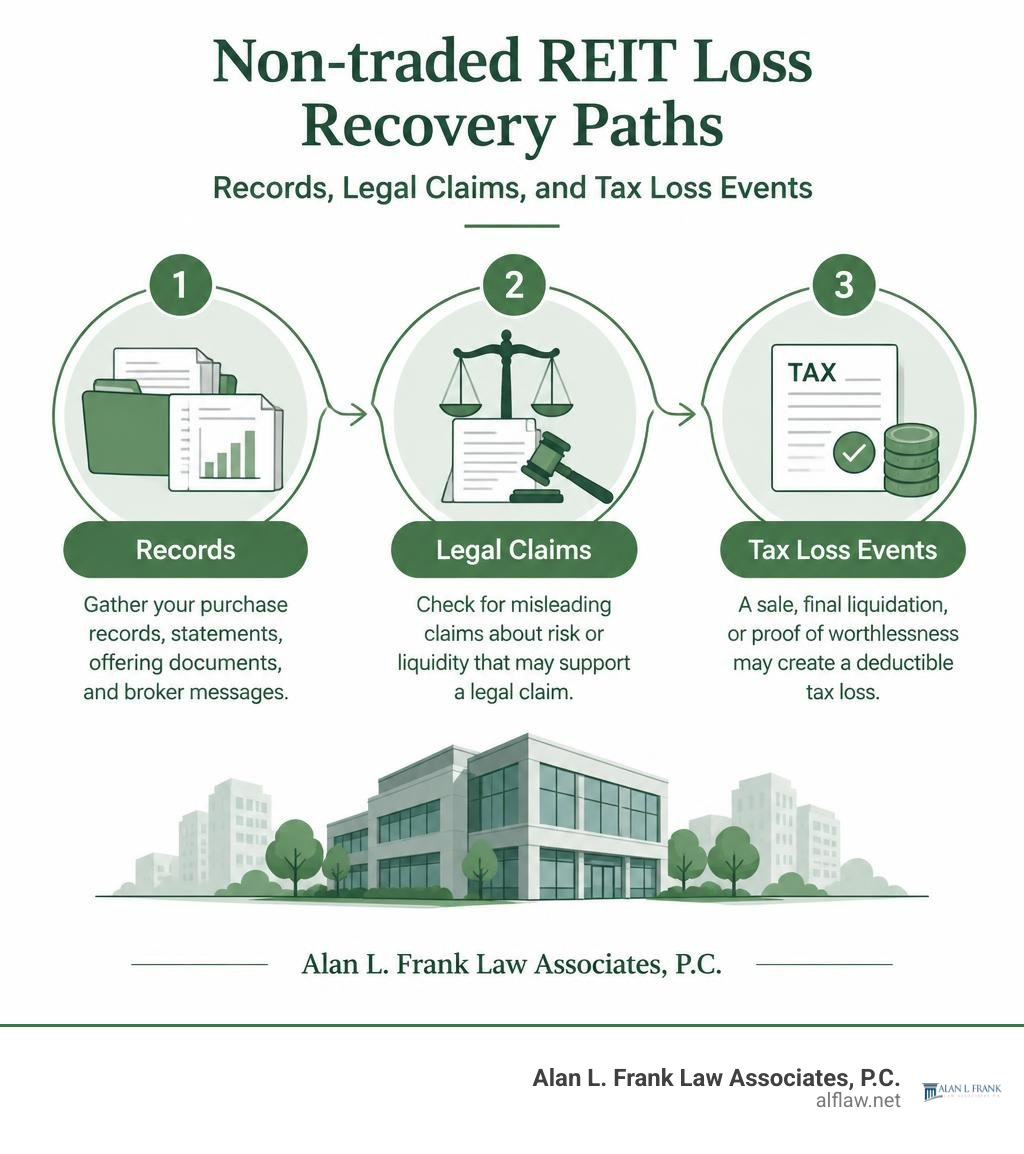
Easy REIT investment loss recovery glossary:
Anatomy of Non-Traded and Crowdfunded REIT Meltdowns
Non-traded Real Estate Investment Trusts (REITs) and syndication platforms are often sold to retail investors as conservative, income-generating alternatives to public stock markets. However, the structural reality behind these products is far more fragile. When credit conditions tighten and property valuations drop, these vehicles face significant operational and liquidity strains.
To understand why so many non-traded products suffer severe declines, it helps to examine historical distress patterns. Academic research on REIT distress and debt maturity reveals that capital structure decisions heavily dictate loss severity:
- Leverage Amplification: A one-standard deviation increase in market leverage historically resulted in a 13.4% decrease in cumulative REIT returns during major market downturns.
- Variable-Rate Exposure: A one-standard deviation increase in variable-rate debt relative to total debt generated an additional 8.9% decline in cumulative returns.
- Debt Rollover Risk: A one-standard deviation increase in debt maturing within two to three years produced an average 7.6% drop in returns as refinancing became prohibitively expensive.
During broader market shocks, the NAREIT All Equity REITs Index dropped 67% (falling from 10,256 in January 2007 to 3,337 in February 2009). The steepest plunge occurred between September 2008 and February 2009, when public REITs plummeted 60%. In comparison, the appraisal-based NCREIF Property Index declined only 15% during that same window. Non-traded and private REITs often rely on internal appraisals that lag real market pricing by several quarters, masking underlying distress. In some cases, poor oversight cross-pollinates with deceptive marketing, making identifying real estate investment scams critical for affected shareholders.
Structural Vulnerabilities: Liquidity Halts and Redemption Freezes
Unlike publicly traded REITs listed on major stock exchanges, non-traded REITs offer zero daily market liquidity. Investors depend entirely on the sponsor’s voluntary Share Repurchase Program (SRP). These repurchase programs usually come with strict quarterly caps—often limiting aggregate redemptions to 2% to 5% of aggregate net asset value (NAV) per quarter.
When multiple investors request their money simultaneously, managers face a liquidity shortfall. Selling physical real estate takes months and incurs heavy transaction costs. Consequently, sponsors routinely exercise their contractual right to gate the fund, leaving investors trapped.
A notable analysis of private REIT redemption freezes highlighted this risk when major institutions faced record withdrawal requests. For example, Blackstone’s $62 billion BREIT saw roughly $3.2 billion returned to investors in late 2023 under its redemption limits after total annual withdrawal requests surged past $13 billion. In the crowdfunding and Reg A+ space, platforms experience similar freezes. MogulREIT I’s NAV dropped from an $11.02 peak down to $6.85 by March 2026 (a 37.8% decline), and MogulREIT II experienced a parallel decline from $10.00 to $6.85, accompanied by an indefinite suspension of its share repurchase program in April 2026.
Restructuring, Default, and Chapter 11 Reorganization
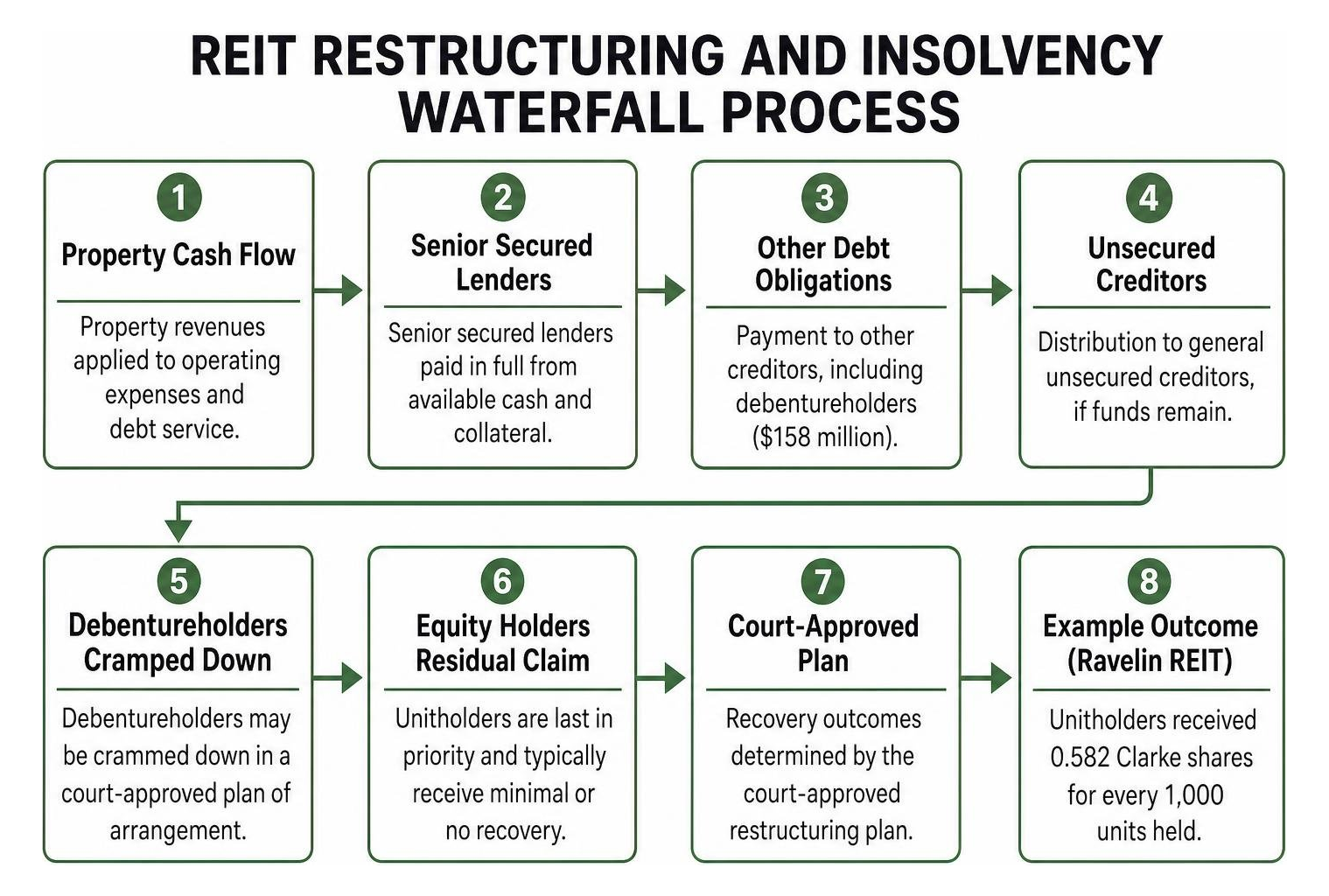
When property revenues cannot cover debt service covenants, restructuring becomes inevitable. Distressed real estate platforms often enter Chapter 11 bankruptcy or cross-border restructurings, which dramatically alter investor recovery outcomes.
For example, the Ontario court case on REIT disclosure obligations involving Ravelin Properties REIT illustrates this dynamic. The trust carried roughly $1 billion in debt across multiple classes, including $158 million owed to debentureholders and $700 million to senior secured lenders. Through a court-approved plan of arrangement, debentureholders were crammed down, and unitholders received just 0.582 Clarke shares for every 1,000 units held—a transaction where equity holders would have otherwise received nothing.
Legal Mechanisms for REIT Investment Loss Recovery
When a non-traded REIT experiences a breakdown, investors are not limited to waiting passively for a sponsor liquidation. Depending on how the investment was recommended and managed, legal avenues exist for taking formal action to recover your investment.
| Recovery Mechanism | Governing Body / Forum | Typical Time Horizon | Primary Eligibility Criteria |
|---|---|---|---|
| FINRA Arbitration | FINRA Dispute Resolution Services | 12 to 18 months | Broker unsuitability, misrepresentation, failure to conduct due diligence |
| Direct Securities Litigation | State or Federal Civil Court | 2 to 4 years | Offering fraud, registration violations, breach of fiduciary duty |
| SEC Fair Funds / Restitution | SEC Administrative / Federal Court | 2 to 5+ years | Established SEC regulatory enforcement against sponsors or brokers |
| Corporate Bankruptcy Claims | U.S. Bankruptcy Court | 1 to 3+ years | Proof of Claim filing as a debtholder or subordinated equity interest |
| SIPC Liquidation | SIPC Trustee / Bankruptcy Court | 6 to 24 months | Broker-dealer failure and missing securities (does not cover market losses) |
FINRA Arbitration and Private Dispute Pathways for REIT Investment Loss Recovery
Most retail non-traded REITs are marketed through independent broker-dealers and registered representatives who earn substantial commissions—often between 7% and 10% upfront. Under FINRA Rule 2111 (and Regulation Best Interest), financial advisors owe duties of suitability and reasonable diligence to their clients.
Brokers frequently breach these standards by:
- Recommending illiquid, high-risk non-traded REITs to conservative or retired investors needing immediate liquidity.
- Over-concentrating a client’s portfolio in a single real estate syndicate or crowdfunding offering.
- Misrepresenting the product as a safe, guaranteed alternative to certificates of deposit or government bonds while glossing over redemption limits.
- Failing to perform independent due diligence on the sponsor’s leverage structure, debt rollover schedules, and internal property valuation models.
By retaining experienced FINRA attorneys, investors can pursue FINRA Dispute Resolution arbitration rather than navigating state or federal courts. According to FINRA guidance on legitimate avenues for loss recovery, claims must be filed within six years of the occurrence or event giving rise to the dispute (FINRA Rule 12206). Engaging in arbitration proceedings in Wall Street private courts provides an efficient, binding forum to seek restitution directly from the brokerage firms that profited from recommending unsuitable products.
Regulatory Restitution, SEC Fair Funds, and SIPC Limits
In addition to individual private arbitration, regulatory bodies occasionally secure broad relief:
- SEC Fair Funds: Under Section 308(a) of the Sarbanes-Oxley Act of 2002, civil penalties and disgorged profits collected by the SEC can be added to an investor distribution fund (Fair Fund) to compensate injured shareholders.
- FINRA Restitution: Regulatory disciplinary orders may mandate that brokerage firms pay formal restitution to impacted customers as a condition of settling enforcement matters.
- SIPC Protection Parameters: It is crucial not to confuse investment failure with brokerage failure. The Securities Investor Protection Corporation (SIPC) protects up to $500,000 per customer (including a $250,000 cap on cash) exclusively when a member brokerage firm becomes insolvent and customer securities go missing. SIPC does not cover drop-in-value losses resulting from bad investments, private market crashes, or illiquid REITs.
Shielding Capital Against Secondary Recovery Scams
Investors seeking to recoup non-traded REIT losses are often targeted by fraudulent secondary recovery enterprises. These advance-fee schemes monitor public bankruptcy dockets, Reg A+ investor lists, and public legal filings, then contact victims claiming they have already frozen assets and can return funds for an upfront fee.
Legitimate regulators and legal counsel do not operate this way. To ensure you are navigating investment loss litigation without getting burned twice, verify that any representative is an attorney in good standing with their respective state bar association, or search broker backgrounds using FINRA BrokerCheck. Never pay upfront wire fees to unverified firms promising guaranteed recovery of lost equity.
Tax Accounting Rules and Loss Harvesting Strategies

When an investment cannot be recovered through litigation or operational turnarounds, understanding federal tax loss mechanisms helps offset gains and reduce overall tax liabilities.
Distinguishing Realized Losses from Unrealized NAV Declines
A common pitfall among real estate investors is attempting to claim a tax deduction based solely on a drop in estimated NAV or a frozen redemption queue.
Under long-standing Internal Revenue Code (IRC) principles, an investment loss is deductible only in the tax year in which it is sustained, as demonstrated by closed and completed transactions and fixed by identifiable events (Treas. Reg. § 1.165-1(d)).
- Unrealized (Paper) Losses: If a sponsor like DiversyFund or MogulREIT slashes NAV from $10.00 to $6.85, the $3.15 decline is purely an unrealized paper loss. You cannot deduct this variance on Form 1040 because the shares have not been liquidated and the underlying entity continues to operate.
- Identifiable Events Fixing a Loss: Events that satisfy the IRS threshold for realization include:
- A completed third-party secondary market sale.
- A final, court-approved Chapter 11 liquidation plan canceling equity interests without recovery (such as PeerStreet’s plan confirmation).
- Receipt of a final Schedule K-1 marked “Final” with capital accounts reduced to zero (as occurred across roughly 30 defaulted debt deals within Yieldstreet/Willow Wealth offerings totaling $208 million in disclosed investor losses).
- A formal corporate dissolution declaring zero residual distributions for equity unitholders.
Tax-Loss Harvesting and Worthless Securities in REIT Investment Loss Recovery
When an equity interest becomes entirely valueless, an investor may utilize specific statutory relief provisions:
1. Worthless Securities — IRC § 165(g)
Under IRC § 165(g)(1), if any security that is a capital asset becomes wholly worthless during the tax year, the resulting loss is treated as a loss from the sale or exchange of a capital asset on the last day of that tax year.
To qualify under § 165(g)(2), the asset must be a share of stock in a corporation, a right to subscribe for stock, or a registered bond, debenture, note, or certificate with interest coupons or in registered form issued by a corporation or government. § 165(g) requires total worthlessness—a severe reduction in value or a partial default does not meet the standard.
2. Extended 7-Year Refund Limitation — IRC § 6511(d)(1)
Ordinarily, the statute of limitations to amend a federal tax return (Form 1040-X) is three years from the date of filing. However, under IRC § 6511(d)(1), taxpayers are granted a special 7-year statute of limitations for refund claims relating to the deductibility of worthless securities under § 165(g) or non-business bad debts under § 166. If an identifiable event occurred in an earlier tax year (e.g., a 2024 bankruptcy confirmation) that was not claimed on that year’s return, you have up to seven years to file an amended return to capture those capital loss deductions.
3. Loss Limitation Cascades
When claiming crowdfunding or syndicate losses, your deductions must pass through several tax code barriers in exact sequence:
- IRC § 465 At-Risk Rules: You can only deduct losses up to the total amount of economic capital you have at risk in the entity.
- IRC § 469 Passive Activity Loss (PAL) Limitations: If you hold an LLC membership interest or partnership-structured crowdfunding asset, losses are classified as passive and generally offset only other passive income, unless a full taxable disposition of your entire interest occurs.
- IRC § 1091 Wash Sale Rules: If you sell a publicly traded REIT or debt security at a loss and repurchase a substantially identical security within 30 days before or after the sale date (a 61-day window), the loss is deferred and added to the cost basis of the new position.
Frequently Asked Questions about Real Estate Trust Losses
Can I deduct a loss on a non-traded REIT that has suspended redemptions?
No. An indefinite suspension of a Share Repurchase Program (SRP) or a severe downward adjustment of reported Net Asset Value is considered an unrealized paper loss. The IRS requires a closed and completed transaction fixed by an identifiable event—such as a formal sale, complete entity dissolution, or a final bankruptcy distribution canceling equity unitholder interests under IRC § 165(g).
How long do I have to file a FINRA arbitration claim for REIT losses?
Under FINRA Rule 12206, an arbitration claim is eligible for submission within six years from the date of the event or occurrence giving rise to the claim (often the initial transaction date or the point when the unsuitable recommendation and non-disclosures occurred). Because determining this timeline involves legal nuances regarding fraudulent concealment or continuous representation, investors should assess their claims promptly.
Does SIPC cover investment losses from a collapsed REIT?
No. SIPC coverage is strictly limited to situations where a registered brokerage firm fails financially and customer assets or cash are physically missing from customer accounts (up to $500,000 total, including a $250,000 cash cap). SIPC does not protect against declines in market value, bad underlying real estate assets, sponsor insolvencies, or fraudulent syndicates. Those damages must be pursued via FINRA arbitration or civil securities litigation.
Conclusion
Navigating the aftermath of a broken non-traded REIT or real estate syndicate requires a dual-track strategy: assessing broker-dealer liability under securities regulations while structuring your tax positions to capture realized capital losses under federal rules.
If your financial advisor placed you into an unsuitable, illiquid non-traded REIT or misrepresented its underlying redemption and leverage risks, taking action early is critical to staying within the applicable FINRA eligibility and civil statutes of limitations. At Alan L. Frank Law Associates, P.C., our practice focuses on evaluating these complex offerings and pursuing securities litigation for investment losses to help investors recover their principal.