
Boundary Line Agreements as Practical Solutions to Encroachment


Boundary Line Agreements as Practical Solutions to Encroachment
What Is a Boundary Line Agreement, and How Can It Help With Encroachment?
A boundary line agreement is a written agreement between neighboring property owners that identifies their shared property line. It is useful when the line is uncertain or a fence, driveway, or other structure appears to cross it. A survey can help the owners describe the line clearly, and recording the agreement can give future buyers notice of it.
For example, if a fence sits beyond the line shown on a survey, the neighbors can use an agreement to settle where the boundary lies and decide what happens to the fence. That clarity may prevent the same dispute from delaying a later sale.
I’m Alan L. Frank, managing attorney at Alan L. Frank Law Associates, P.C., with more than 20 years of experience leading a firm that handles complex litigation, including construction defect disputes. If you’re asking “what is a boundary line agreement,” this guide explains what it can resolve and when a property dispute may need more than an agreement.
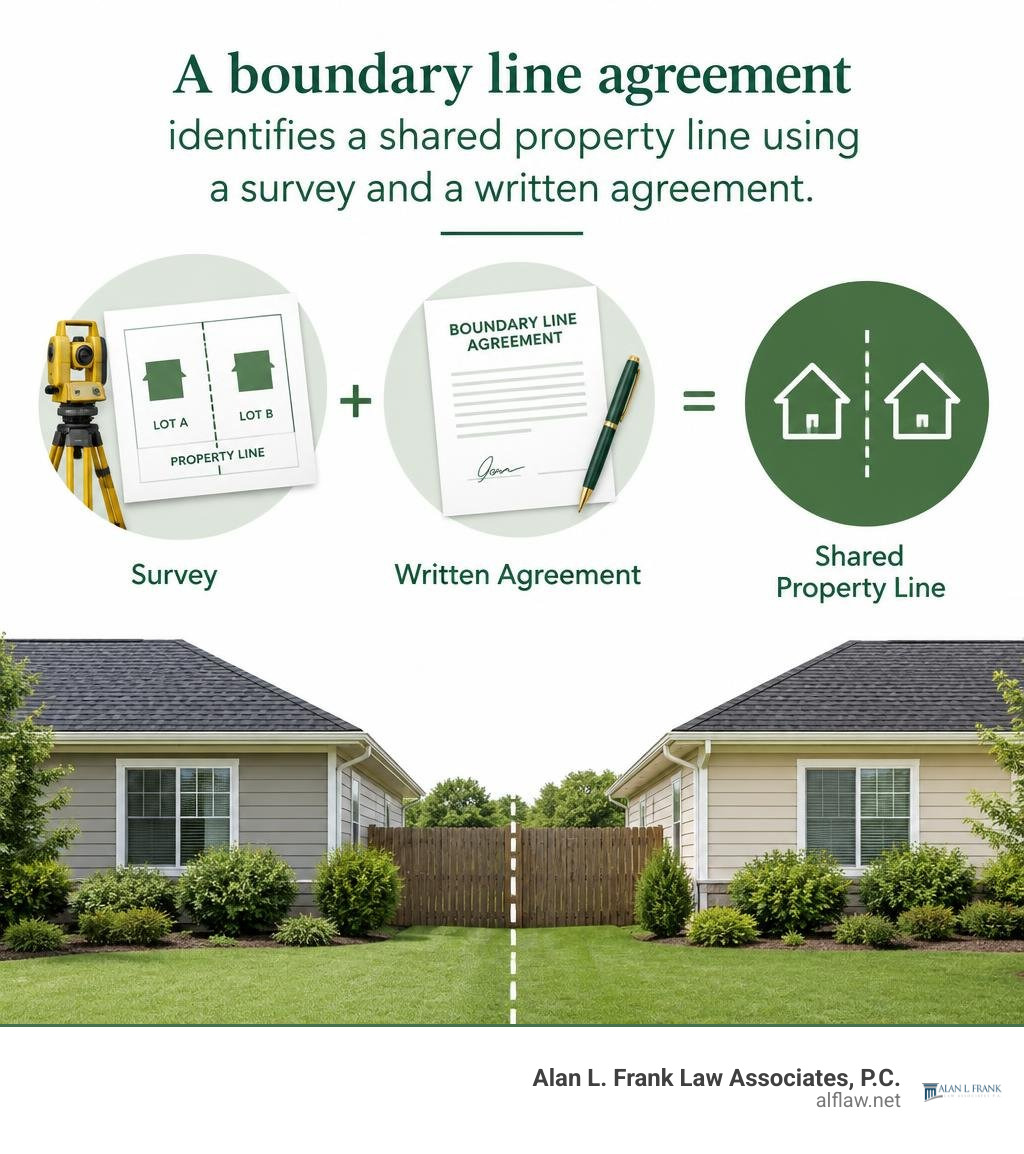
What is a boundary line agreement terms explained:
What Is a Boundary Line Agreement and When Is It Used?
Property boundaries seem straightforward until a new project begins, an old fence rots away, or a parcel changes hands. Suddenly, adjoining landowners realize that the line they thought marked their property does not match official survey stakes. When property lines are ambiguous, unmonumented, or conflicting, adjacent owners must find a definitive way to establish certainty. In our practice across Pennsylvania and New Jersey, we routinely see property owners explore how homeowners can successfully challenge disputed boundary lines without turning their neighborhoods into legal battlegrounds.
A boundary line agreement functions as a formal contract between adjoining landowners. Instead of dragging each other into court to argue over vague historical descriptions or missing boundary monuments, the parties come together, identify the uncertain dividing line, and execute a legally binding instrument that establishes the line’s exact placement on the ground.
Understanding What a Boundary Line Agreement Is in Real Estate
At its core, understanding what a boundary line agreement is requires looking at contract law and property conveyance principles. When two adjacent landowners have an uncertain or disputed property division, they hold the legal authority to resolve that ambiguity by mutual consent.
Historically, deed descriptions often relied on natural landmarks that shift or vanish over decades—such as a fallen oak tree, a creek bed, or a wooden stake that rotted long ago. When newer survey technologies identify discrepancies between deed calls and current physical occupation, title confusion emerges. Property owners can often check where to find existing property surveys without ordering a new one through municipal archives or title records, but if the historical records conflict, a boundary line agreement provides the mutual consent needed to fix the line once and for all.
Common Encroachment Scenarios Resolved by Boundary Agreements
Encroachments are among the most frequent catalysts for boundary line agreements. Many property owners discover encroachments by accident during home renovations, sales, or refinancing. Some of the most common scenarios we encounter include:
- Misaligned Fences: A previous owner erected a privacy fence three feet inside a neighbor’s parcel thirty years ago, and both properties have treated the fence as the de facto property line ever since.
- Paved Driveways: A driveway or asphalt apron slightly crosses over the boundary line, creating potential adverse possession exposure or access disputes.
- Structural Overhangs and Eaves: Garage roofs, shed gutters, or building eaves that extend across the airspace of an adjoining parcel.
- Outbuildings and Retaining Walls: Sheds, patios, garden walls, or concrete structures positioned slightly past the boundary line.
Addressing these issues early is critical. Reviewing the homebuyer’s guide to obvious property problems helps buyers identify these visual red flags before closing so they can demand a formal agreement rather than inheriting an active dispute.
Key Distinctions: Boundary Line Agreements vs. Adjustments, Easements, and Licenses
Property owners frequently confuse the various legal mechanisms available for resolving boundary and encroachment problems. The choice between an agreement, an adjustment, an easement, or a license determines whether municipal approval is necessary and what property rights are conveyed.
| Legal Instrument | Purpose | Municipal Approval Required? | Transfers Ownership? | Permanent / Runs with Land? |
|---|---|---|---|---|
| Boundary Line Agreement | Clarifies an uncertain, disputed, or ambiguous property line | Generally No (exempt from subdivision rules) | Establishes agreed legal boundary | Yes (when recorded) |
| Lot Line Adjustment | Relocates a known, undisputed boundary line between lots | Yes (Planning Board / Subdivision review) | Yes (via deed exchange) | Yes (updates tax/lot maps) |
| Express Easement | Grants a specific, non-possessory right to use land | No | No (grantor retains fee title) | Yes (if appurtenant and recorded) |
| Encroachment License | Grants personal, revocable permission for a structure | No | No (permissive use only) | No (typically personal/revocable) |
Before executing any document, landowners should review understanding prescriptive easements and property use rules to evaluate whether a neighbor’s long-term use has already ripened into a legally enforceable right.
Boundary Line Agreement vs. Lot Line Adjustment
The distinction between a boundary line agreement and a lot line adjustment is one of the most critical concepts in municipal land use. According to title guidance published in TITLE TALK with Katie Button, a lot line adjustment intentionally moves a known, undisputed boundary to alter lot sizes, which classifies it as a minor subdivision subject to mandatory planning board approval.
Conversely, a boundary line agreement does not create a new lot or intentionally alter known deed lines for development purposes; rather, it resolves an uncertainty where the true line cannot be determined with certainty. Because it merely confirms and settles an ambiguous line rather than creating a subdivision, a properly drafted boundary line agreement generally bypasses the months of bureaucratic hearings and expenses associated with municipal planning boards.
Boundary Line Agreement vs. Easement and Encroachment License
An easement confers a non-possessory property right, granting one party the legal right to use another party’s real estate for a defined purpose (such as a shared driveway or utility corridor) while fee simple ownership remains unchanged. Landowners exploring access rights can review easement by necessity basics every landowner must know to see how courts handle landlocked parcels.
An encroachment agreement or license, by comparison, provides permissive, often temporary authorization for a structure to remain in place without altering property lines or transferring ownership. A boundary line agreement goes a step further: it permanently establishes the boundary itself, realigning title ownership on either side of the agreed line and eliminating the underlying encroachment entirely.
Essential Components and Legal Requirements for Enforceability

A boundary line agreement is a formal conveyance of real property rights. To be legally binding and enforceable against future purchasers, it must comply with real estate contract statutes, including the Statute of Frauds, mutual consideration, and official recording acts. Additional drafting insights can be found in resources discussing Boundary Line Agreement: What is it? Terms, Considerations.
Core Drafting Elements and Required Exhibits
To ensure lasting enforceability, an effective boundary line agreement must include several mandatory sections:
- Accurate Identification of Parties: Full legal names of all titled owners of both adjoining properties, matching the recorded vesting deeds.
- Recitals and Background Context: Clear statements explaining the uncertainty, ambiguity, or dispute regarding the common property line, establishing the legal justification for the contract.
- Precise Legal Metes-and-Bounds Description: A detailed, surveyor-certified legal description defining the newly agreed boundary line with exact measurements, bearings, and pins.
- Reciprocal Quitclaim and Conveyance Language: Mutual grants where each party releases and quitclaims to the other any right, title, or claim to land lying on the opposite side of the agreed line.
- Covenants Running with the Land: Express language stating that the agreement binds all heirs, successors, executors, and future assigns of both parcels.
- Maintenance and Improvements: Clear terms detailing which owner is responsible for maintaining fences, retaining walls, or shared physical buffers along the line.
- Survey Exhibit: A certified survey plat prepared by a licensed surveyor attached as an official exhibit and incorporated by reference.
Execution, Notarization, and County Recording Requirements
Drafting the agreement is only half the battle. To protect property owners from future claims, the document must be formally executed:
- All Signatures Required: Every individual or entity holding an ownership interest in either parcel must sign. If a property is owned jointly by spouses or held in a trust, all trustees and title holders must execute the document.
- Notary Acknowledgment: Signatures must be formally acknowledged before a licensed notary public in accordance with state recording laws.
- Mortgage Lienholder Consent: If either property is subject to an active mortgage or deed of trust, the lender holds a secured interest in the land. Failure to obtain a partial mortgage release or lienholder consent could violate mortgage covenants or leave the agreement vulnerable to foreclosure wipeout.
- County Recording: The executed agreement and survey plat must be filed in the land records office (such as the County Recorder of Deeds) where the properties are situated, providing constructive public notice to all future buyers and title examiners.
Step-by-Step Process for Establishing a Boundary Line Agreement
Resolving a boundary dispute requires a structured, collaborative approach to avoid escalating interpersonal conflict. Landowners can reference strategies in How to Settle a Property Line Dispute to navigate these steps methodically.
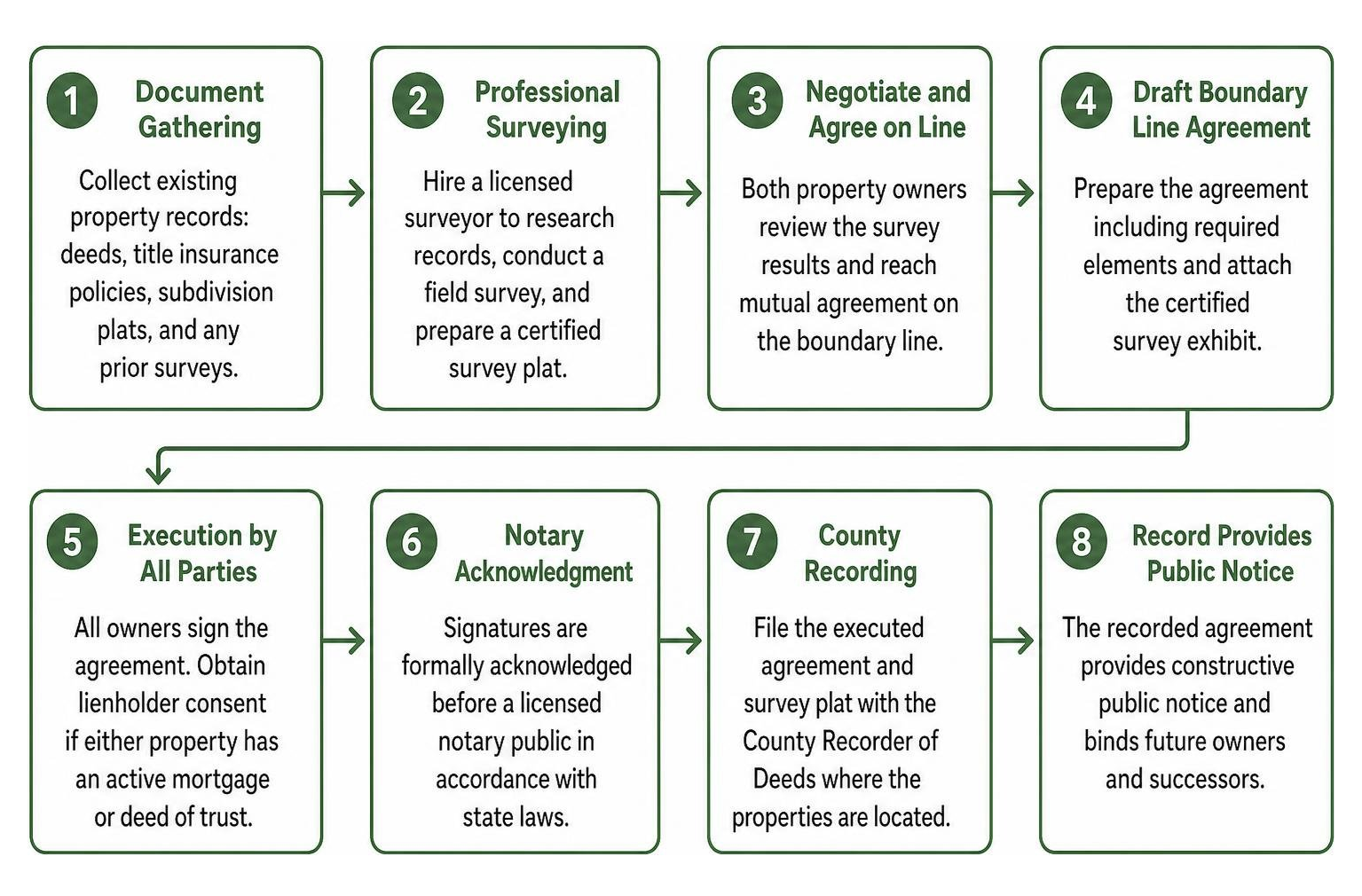
Step 1: Document Gathering and Professional Surveying
The process begins with thorough factual research:
- Collect Existing Property Records: Gather current deeds, title insurance policies, subdivision plats, and any prior surveys.
- Retain a Licensed Professional Land Surveyor: A licensed surveyor conducts on-site field measurements, locates existing iron pins or historical monuments, reviews deed descriptions, and maps any existing physical encroachments. A residential boundary survey typically costs between $300 and $1,000 for a standard parcel.
- Establish the Uncertainty: The surveyor identifies discrepancies between deed descriptions and physical occupation, providing the objective foundation for the agreement.
Step 2: Negotiation, Legal Drafting, and Title Clearance
Once survey data is available, the parties formalize their resolution:
- Neighbor Negotiations: The adjoining owners discuss practical boundary solutions based on the surveyor’s findings. If direct talks stall, professional mediation typically costs between $500 and $2,000 and helps parties reach common ground without litigation.
- Legal Drafting by Real Estate Counsel: An attorney drafts the boundary line agreement, integrating the surveyor’s new metes-and-bounds descriptions and conveyance recitals.
- Lender and Title Review: The draft is submitted to title insurers and mortgage lenders to secure necessary subordinations or approvals.
- Execution and Public Recording: Parties sign the document before a notary, and the agreement is officially recorded in the county land records.
Advantages of Boundary Line Agreements Over Real Estate Litigation
When boundary disputes arise, emotional reactions can lead property owners to threaten lawsuits. However, negotiating a boundary line agreement offers distinct financial and personal benefits over courtroom conflict. In our guide on how to sue your neighbor without starting a full-blown neighborhood war, we emphasize the value of finding private legal remedies before filing public claims.
Avoiding Expensive Court Battles and Quieting Title Actions
Taking a property line dispute into court via a quiet title action, ejectment lawsuit, or adverse possession claim is financially draining. If a property line dispute ends up in court, legal fees can quickly range from several thousand to tens of thousands of dollars, far exceeding the value of the disputed sliver of land.
Understanding what real estate litigation entails and when representation is needed highlights just how protracted courtroom battles can become. A boundary line agreement resolves the underlying legal dispute for a fraction of the cost, preserving neighborly relations and keeping control of the outcome in the hands of the property owners rather than a judge or jury.
Protecting Future Property Transactions and Title Insurance
Unresolved boundary disputes act as immediate roadblocks during property sales and mortgage refinances. Title insurance underwriters routinely flag visible encroachments or overlapping deed descriptions on Schedule B of a title commitment. If left unaddressed, these title exceptions can cause buyers to cancel contracts or lenders to deny loan approvals. When hidden defects or boundary issues emerge post-closing, property owners often find themselves asking when to call a real estate defect attorney. Executing and recording a boundary line agreement cures these title defects permanently, ensuring clear, marketable title for future transactions.
Frequently Asked Questions About Boundary Line Agreements
What is a boundary line agreement and does it run with the land?
A boundary line agreement is a formal, recorded legal contract between adjoining property owners that defines and establishes an ambiguous or disputed common boundary. When properly drafted with covenant language, executed by all title holders, and recorded with the county recorder of deeds, the agreement runs with the land. This means it permanently binds all future purchasers, heirs, and successors to both parcels.
Does a boundary line agreement require municipal planning board approval?
In most jurisdictions, a boundary line agreement does not require municipal planning board or zoning board approval because it settles an uncertain, disputed boundary rather than creating a new subdivision or altering known lot configurations for commercial development. However, if the adjustment alters parcel dimensions significantly enough to violate local zoning setback minimums or minimum lot size requirements, municipal review may be triggered. Consulting with legal counsel ensures the agreement complies with local ordinances.
How does a boundary line agreement affect existing mortgages and title policies?
Because a boundary line agreement involves quitclaim conveyances that adjust the physical boundaries of encumbered land, it directly impacts existing mortgage liens. If an owner conveys away a portion of their titled land without their mortgage lender’s knowledge, they could theoretically trigger a technical default under their mortgage covenants. For substantial boundary adjustments, obtaining lender consent or a partial mortgage release ensures the boundary line agreement remains fully valid and superior to existing liens.
Conclusion
Boundary disputes and structural encroachments do not have to escalate into contentious, expensive courtroom litigation. By executing a properly drafted and recorded boundary line agreement, adjoining landowners can permanently establish their property lines, protect their market value, and ensure smooth real estate transactions for years to come.
If you are dealing with a property boundary discrepancy, fence encroachment, or title ambiguity in Pennsylvania or New Jersey, our team at Alan L. Frank Law Associates, P.C. can assist. With offices in Philadelphia and Jenkintown, we bring deep experience in real estate law and civil dispute resolution to help clients secure lasting property certainty. Explore our experienced commercial litigation and real estate dispute counsel to schedule a consultation and resolve your boundary issues effectively.