
When Green Promises Turn to Red Flags in Wall Street ESG Portfolios


When Green Promises Turn to Red Flags in Wall Street ESG Portfolios
When an ESG Fund’s Promises Don’t Match Its Portfolio
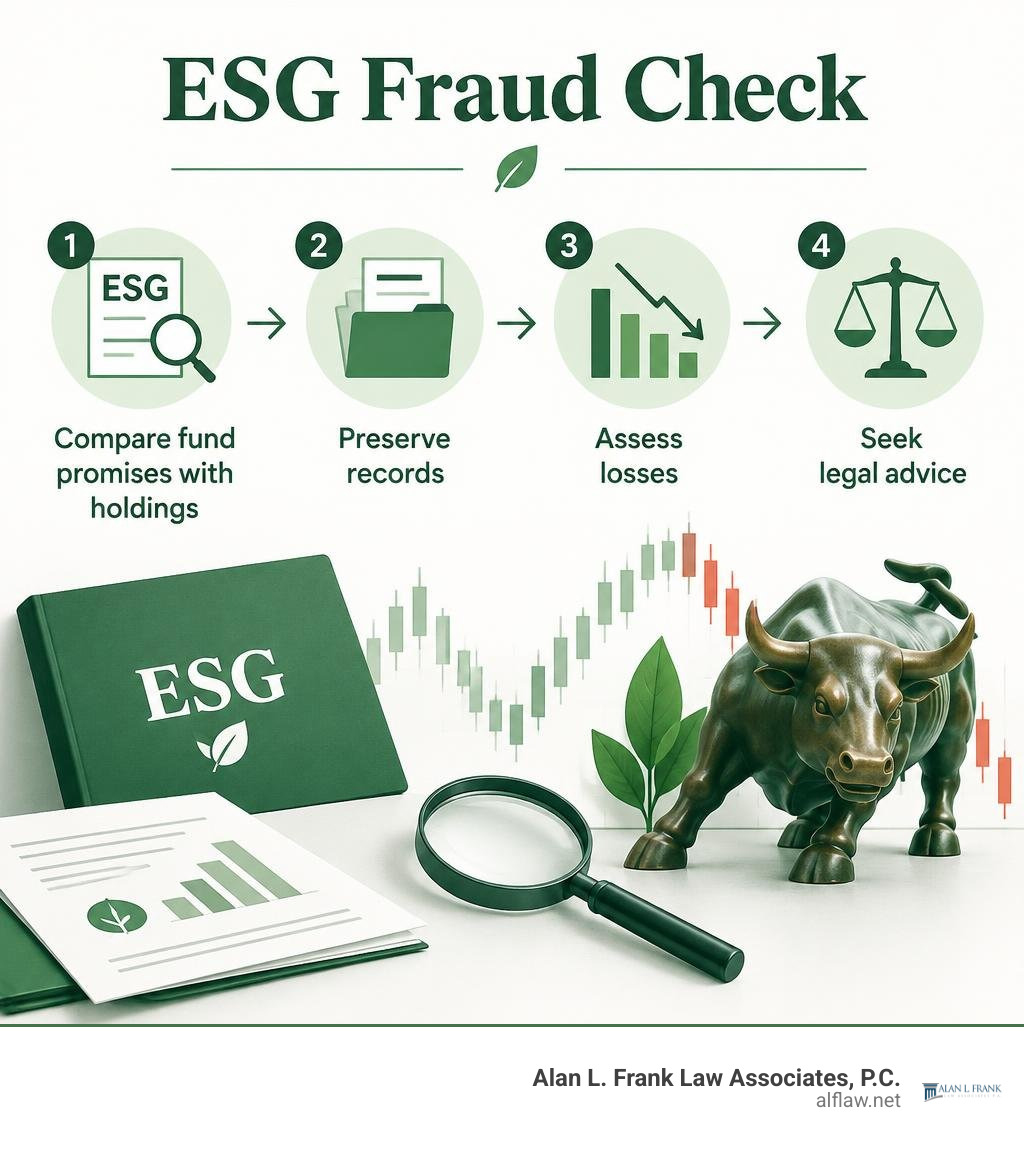
If an ESG fund’s holdings or screening process contradict what you were told, save the prospectus, ads, account statements, and messages with your adviser. An ESG investment fraud attorney can compare those promises with what the fund actually did, assess your losses, and determine whether you have a claim. A disappointing return alone is not proof of fraud.
Investors should not have to guess whether “sustainable” describes an investment process or just a sales pitch. When a firm charges for ESG investing but misstates how it selects or reviews holdings, the gap deserves scrutiny.
I’m Alan L. Frank, a CPA and attorney with more than 20 years leading litigation involving investment losses, securities, and business disputes. As an ESG investment fraud attorney, I would start with the documents: what was promised, what happened, and whether the difference caused a recoverable loss.
Must-know ESG investment fraud attorney terms:
The Anatomy of Greenwashing: How Sustainable Portfolios Deceive Investors
Sustainable investing was supposed to bridge the gap between capital growth and corporate responsibility. Instead, it frequently functions as an aggressive marketing funnel designed to harvest premium management fees. Wall Street asset managers quickly realized that stamping “Environmental, Social, and Governance” (ESG) onto a fund wrapper allowed them to charge significantly higher expense ratios without altering the underlying investment machinery.

This fee inflation is not just aggressive salesmanship—it often crosses directly into fraudulent misrepresentation. When fund sponsors claim that proprietary algorithmic models conduct rigorous ethical screening across every holding, yet fail to execute those reviews, they breach their core fiduciary duties. Academic research, including studies published in the New York University Journal of Law & Business, has demonstrated that environmental funds frequently fail to reduce aggregate carbon footprints when compared against conventional market indices. When these discrepancies lead to severe financial damage, investigating complex securities litigation becomes the necessary path to uncover institutional misconduct.
| Operational Area | Legitimate ESG Compliance | Fraudulent Marketing & Greenwashing |
|---|---|---|
| Portfolio Screening | Documented, mandatory exclusion of restricted sectors with regular compliance audits | Marketing strict negative screens while holding prohibited assets under modified index wrappers |
| ESG Integration | Formal scoring methodologies applied to 100% of portfolio positions prior to purchase | Overstating integration metrics; skipping reviews for significant percentages of assets |
| Carbon Accounting | Verified, third-party audited Scope 1, 2, and 3 greenhouse gas tracking | Utilizing unverified offsets, double-counting credits, and relying on self-reported estimates |
| Fee Structures | Transparent fees reflecting specialized research overhead and active stewardship | Inflating expense ratios solely for cosmetic ESG branding without enhanced analytical rigor |
Unmasking Portfolio Composition and Exclusionary Screening Failures
The most direct form of deception occurs when funds violate their own stated exclusionary screens. Retail and institutional investors purchase funds marketed as “fossil-fuel-free,” “weapons-free,” or “ethically screened,” only to discover that the underlying portfolios quietly hold substantial legacy oil, defense, or tobacco positions.
Fund managers frequently rely on loose definitions of “transition companies” or obscure derivative instruments to bypass their own prospectus restrictions. They track broader benchmark indices to avoid trailing standard market returns, pulling prohibited assets into the fund to sustain performance while continuing to promote the vehicle as strictly sustainable.
Carbon Offset Fraud and Double-Counting Schemes
Green deception often extends into the accounting metrics used to justify environmental scores. Many funds rely heavily on corporate carbon offset claims to manufacture low-carbon profiles.
In practice, these offsets frequently suffer from structural double counting—where a single emissions-reduction initiative is claimed simultaneously by the project developer, the issuing broker, and multiple institutional buyers. When portfolios rely on phantom credits or unverified greenhouse gas (GHG) reductions across opaque supply chains, the valuation metrics presented to retail investors become materially misleading.
Regulatory Precedents: How Recent SEC Enforcement Actions Shape Investor Claims
Federal and state regulatory bodies have escalated their enforcement posture against investment advisers who market responsible investing strategies without substantive operational compliance. Regulatory oversight under the Investment Advisers Act of 1940 and the Investment Company Act of 1940 has established that misstating investment screening methodologies constitutes an actionable disclosure failure. Whether evaluating public fund prospectuses or analyzing private placement fraud and issuer misrepresentations, administrative findings provide vital evidentiary roadmaps for private loss recovery.
The Evidentiary Value of Landmark SEC Penalties
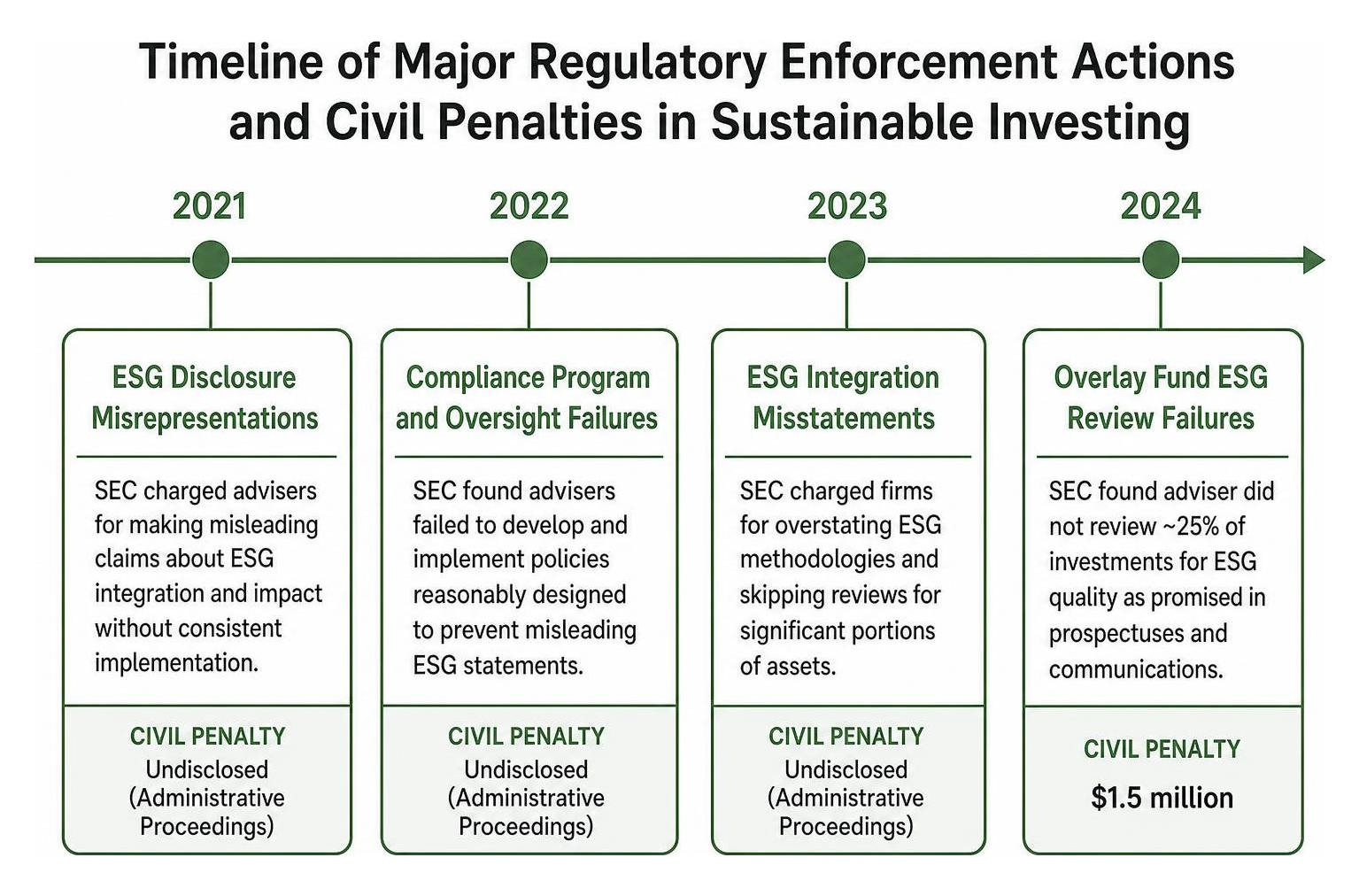
Recent regulatory enforcement actions demonstrate the systemic nature of ESG marketing discrepancies across major financial institutions:
- BNY Mellon Investment Adviser, Inc.: Settled SEC administrative charges by paying a $1.5 million civil penalty after the Commission revealed that approximately 25% of investments within its overlay fund lacked the mandatory ESG quality reviews promised in fund prospectuses and advisory communications, as detailed in the official findings of the SEC administrative order.
- Goldman Sachs Asset Management: Agreed to a $4 million civil penalty to resolve an SEC investigation into internal policy failures, where portfolio teams failed to follow established ESG research procedures before asset purchases.
- WisdomTree Asset Management: In late 2024, the SEC imposed a $4 million civil penalty over inaccurate disclosures regarding the actual exclusionary screening utilized across dedicated ESG exchange-traded funds.
- Invesco Advisers: Paid a $17.5 million civil penalty following findings that the firm overstated the degree of commercial ESG integration across hundreds of billions in client assets.
State-Level Scrutiny and Consumer Protection Challenges
Beyond federal administrative enforcement, state regulators and attorneys general have launched independent inquiries into investment houses over deceptive fund characterizations. State retirement boards and oversight authorities in jurisdictions throughout Pennsylvania and New Jersey have scrutinized whether fund advisers violated state consumer protection laws and common-law fiduciary standards by engaging in misleading sales practices. These regulatory records reinforce private claims that asset managers prioritize fee generation over adherence to disclosed investment criteria.
Legal Recourse and Loss Recovery: Statutes, Forums, and Whistleblower Actions
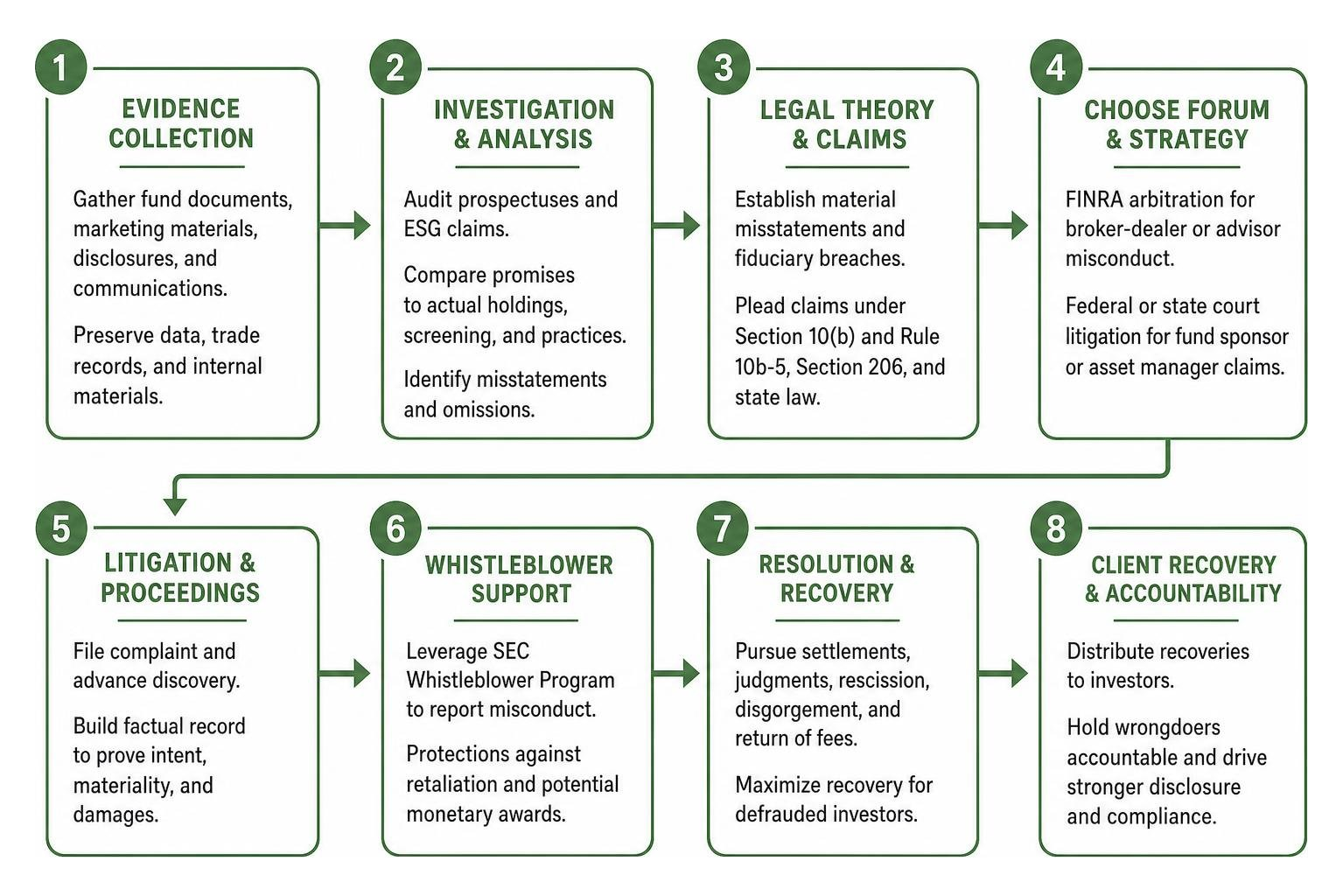
Victimized investors are not limited to waiting for regulatory fines that rarely make defrauded market participants whole. Private securities litigation provides robust legal pathways to seek actual damages, rescission of investment contracts, and disgorgement of inflated advisory fees. Federal claims under Section 10(b) of the Securities Exchange Act of 1934 and SEC Rule 10b-5 target material misstatements, while Section 206 of the Investment Advisers Act establishes remedies for fiduciary breaches.
Strategic pleading requires deep familiarity with jurisdictional damage standards. In the Eastern District of Pennsylvania, the court addressed standing, choice of law, and actual loss recovery requirements in Burns v. Stratos (Burns v. Stratos, 581 F.Supp.3d 687 (E.D. Pa. 2022)) – vLex United States (and its underlying records in BURNS v. STRATOS (trial court document), District Court, E.D. Pennsylvania, 2022 ), highlighting that plaintiffs must meticulously plead recoverable out-of-pocket damages rather than speculative expectation damages. When corporate misconduct occurs behind closed doors, understanding investor rights under the SEC whistleblower program allows individuals with inside access to safely expose deceptive practices.
FINRA Arbitration Versus Federal Court Litigation
The legal venue for an ESG fraud claim depends on the nature of the transaction and the parties involved:
- FINRA Arbitration: If your retail broker-dealer or financial advisor recommended an unsuitable ESG product based on false marketing claims or unverified ratings, claims are typically resolved through mandatory FINRA dispute resolution. Securing representation by experienced FINRA attorneys levels the playing field against brokerage firms, often providing a resolution within 12 to 18 months.
- Federal or State Court Litigation: If the claim targets the fund sponsor, institutional issuer, or asset manager directly for prospectus fraud or common-law deceit, federal or state courts provide the proper forum for individual or class actions.
The Crucial Role of SEC Whistleblowers in Uncovering Fund Misconduct
Internal compliance officers, data analysts, and portfolio managers frequently recognize greenwashing schemes long before public disclosures reveal the truth. Under the Dodd-Frank Act, the SEC Whistleblower Program provides substantial monetary bounties—ranging from 10% to 30% of collected monetary sanctions—alongside robust statutory protections against employer retaliation, which align with protections detailed when navigating Sarbanes-Oxley fraud claims and whistleblower retaliation protections.
Why Victimized Investors Need an ESG Investment Fraud Attorney
Unraveling institutional investment fraud requires parsing complex quantitative portfolios and dissecting sophisticated legal disclosures. Fund managers defend themselves by arguing that ESG descriptions are merely subjective non-binding goals or standard promotional marketing. When capital is lost due to misrepresentations, why smart investors trust stock fraud attorneys to reclaim stolen capital becomes obvious: specialized litigators know how to pierce these corporate defenses and hold sponsors accountable through comprehensive navigating investment loss litigation strategies.
How an ESG Investment Fraud Attorney Proves Intent and Materiality
To establish liability, counsel must demonstrate that the misrepresentation was material—meaning a reasonable investor would have considered it significant—and that the fund acted with scienter (intent or severe recklessness):
- Forensic Prospectus Auditing: Cross-referencing marketing promises against actual daily trade blotters and portfolio holdings.
- Review of Internal Compliance Communications: Demonstrating that management knew portfolio screening criteria were being ignored to cut research costs or track general indices.
- Loss Causation Modeling: Isolating the exact financial injury caused by the fund’s true risk profile versus general market contractions.
Selecting the Right ESG Investment Fraud Attorney for Complex Litigation
When asset values collapse due to improper portfolio management or misstated risks, securities losses demand the right investment fraud attorneys near me who possess the resources to challenge Wall Street legal teams. Look for legal representation that brings together deep CPA-level financial forensic capabilities with extensive trial experience in regional courts across Pennsylvania, New Jersey, and national arbitral forums.
Frequently Asked Questions About ESG Investment Misrepresentation
What is the legal difference between marketing greenwashing and actionable ESG securities fraud?
Vague marketing statements such as “we care about the planet” are often classified as non-actionable puffery. However, when a fund states specific, objective criteria in its prospectus—such as “100% of holdings undergo proprietary carbon-intensity screening” or “we strictly exclude fossil fuel extractors”—and fails to follow those rules, the statement becomes a material misrepresentation actionable under federal and state securities laws.
What is the statute of limitations for filing an ESG investment fraud claim?
For federal claims under Rule 10b-5, the statute of limitations requires filing within two years of discovering the fraud, and no later than five years from the date of the deceptive transaction (the statute of repose). Claims brought through FINRA arbitration are subject to a six-year eligibility rule from the event giving rise to the dispute.
Can investors recover damages if an ESG fund simply suffered broader market losses?
You cannot recover investment losses caused purely by broad market declines. However, you can recover damages if the manager’s failure to adhere to stated ESG screens exposed the fund to unannounced sectoral risks, volatility, or inflated management fee premiums that directly contributed to your out-of-pocket losses.
Conclusion
Sustainable investing should represent genuine corporate accountability, not an excuse for institutional deception. When fund managers exploit ethical mandates to collect inflated fees while violating basic investment disclosures, investors have a clear legal right to demand financial recovery.
At Alan L. Frank Law Associates, P.C., we combine forensic accounting insight with aggressive courtroom advocacy across Pennsylvania and New Jersey to hold dishonest asset managers accountable. If you suspect your sustainable portfolio concealed improper holdings or systemic compliance failures, take action by recovering capital through dedicated securities litigation for investment losses and protecting your financial rights today.