
When Buildings Fail and How Construction Defect Insurance Steps In


When Buildings Fail and How Construction Defect Insurance Steps In
How to Start a Construction Defect Insurance Claim
For construction defect insurance claims, start by documenting the problem and any damage it caused. Save photos, contracts, plans, inspection reports, repair records, and the date you first noticed the issue. Notify the relevant insurers promptly, but avoid making permanent repairs before they can inspect the damage unless safety or further damage makes repairs necessary. Keep the cost of fixing the faulty work separate from the cost of repairing damage it caused; the policy may treat them differently.
A hidden leak can damage walls long before anyone sees it. Finding the cause, identifying who may be responsible, and matching the loss to the right policy are often the hardest parts of a claim.
I’m Alan L. Frank, Managing Attorney at Alan L. Frank Law Associates, P.C., where construction defects are among the disputes our firm handles. I bring more than 20 years of litigation leadership to complex disputes, including issues that can arise in construction defect insurance claims.
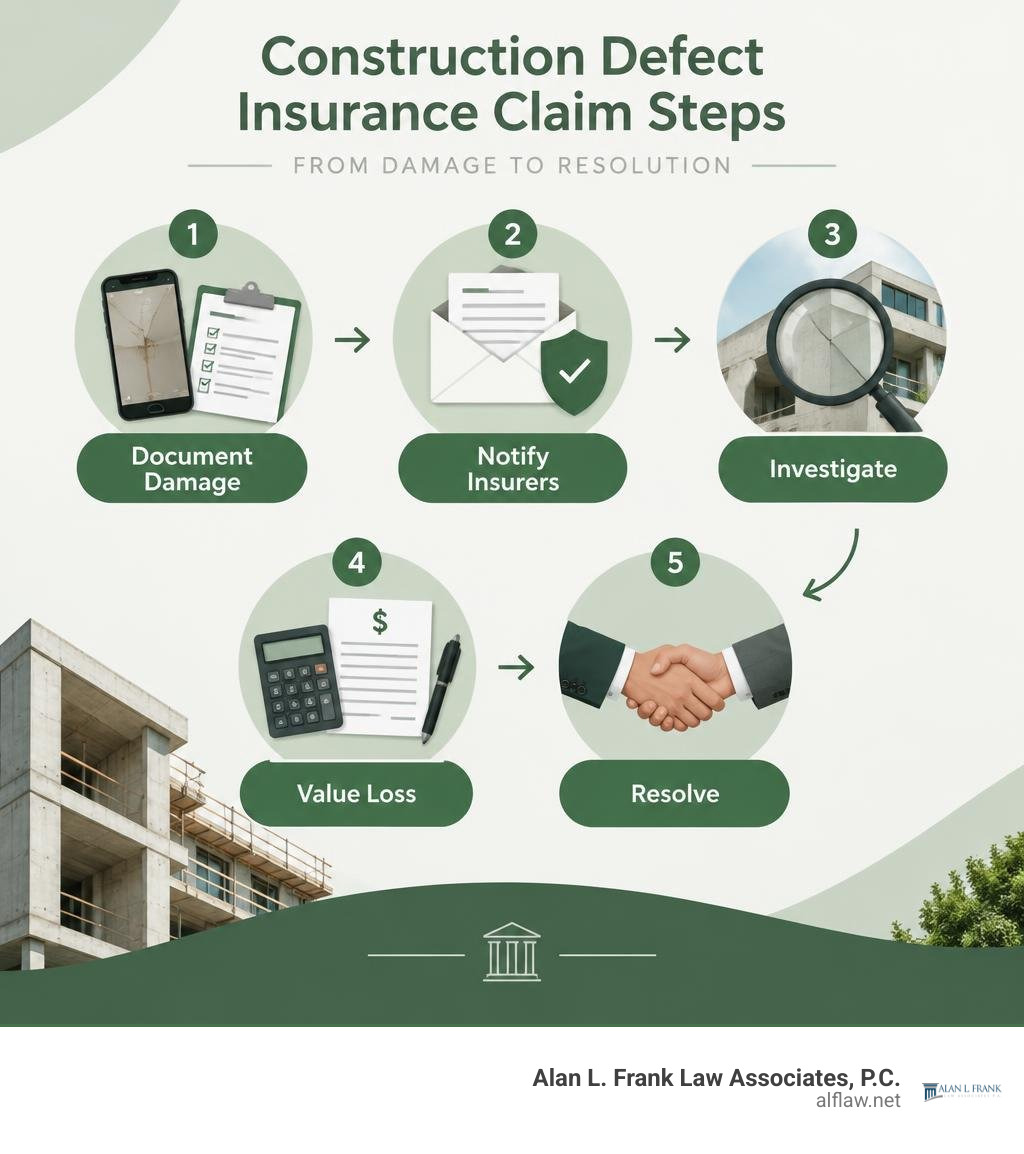
Construction defect insurance claims terms made easy:
Identifying Construction Defects: Categories, Manifestations, and Liability
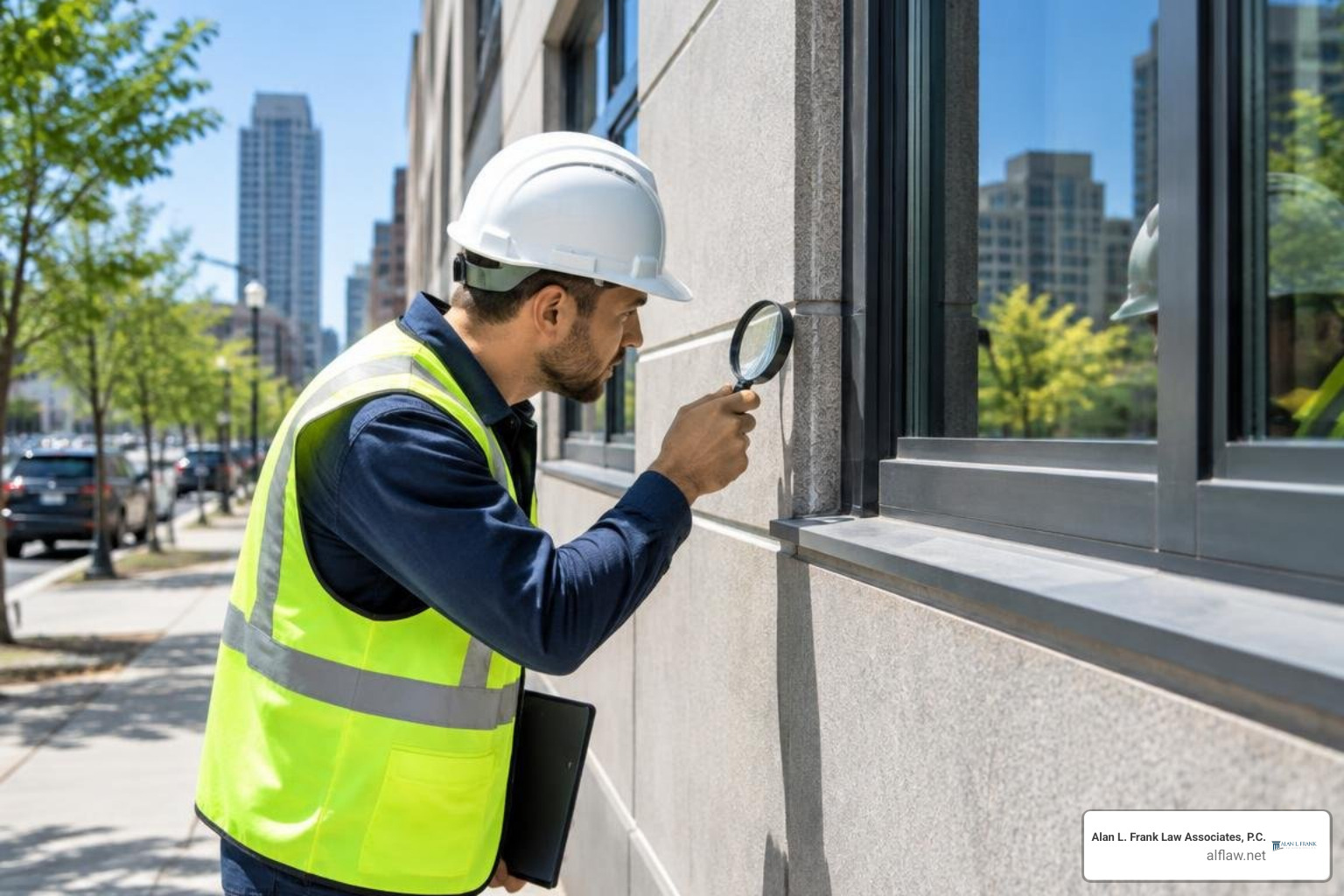
When a structure fails to perform as planned, determining whether the breakdown stems from poor workmanship, substandard products, or architectural oversights is the critical first step. Identifying defects requires looking past surface-level symptoms to isolate the root engineering failure. Navigating this process begins with a guide to spotting deal-breaking material defects to separate superficial cosmetic issues from major structural liabilities.
Understanding Design, Material, and Workmanship Deficiencies
Construction defects generally fall into four primary categories:
- Design Deficiencies: Architectural and engineering errors, such as inadequate roof drainage slopes, insufficient structural load calculations, or improper building envelope ventilation.
- Material Deficiencies: Inferior, damaged, or non-conforming building products, including defective waterproofing membranes, sub-grade concrete mixes, or compromised window assemblies.
- Workmanship Deficiencies: Poor installation practices and contractor negligence, such as missing flashing, improperly driven fasteners, or inadequate soil compaction.
- Operational and Maintenance Deficiencies: Failures in ongoing systems maintenance that exacerbate existing structural flaws.
Taking prompt action helps you protect your project before the roof caves in and preserves crucial physical evidence before temporary fixes obscure the underlying cause.
Patent vs. Latent Defects in Property Failures
The law draws a sharp distinction between patent and latent defects:
- Patent Defects: Open, visible, and discoverable flaws upon reasonable inspection at project completion, such as cracked paving, unpainted surfaces, or visibly misaligned framing. Guidance on visible flaws is detailed in the homebuyer’s guide to obvious property problems.
- Latent Defects: Concealed, hidden flaws that lurk beneath finishes, within foundations, or behind exterior cladding. These issues may take years to manifest as visible decay. Uncovering these hidden risks is explored in the secret life of latent defects in your new home.
Apportioning Liability Across Project Stakeholders
Pinpointing financial and legal responsibility requires evaluating contract chains and scopes of work:
- General Contractors: Hold prime contractual responsibility for project execution and site supervision.
- Subcontractors: Liable for trade-specific execution, such as framing, plumbing, roofing, and masonry.
- Architects and Engineers: Bear professional liability for plan specifications, code compliance, and structural integrity.
- Developers and Material Suppliers: Held accountable for product warranties and representations regarding building habitability.
Securing experienced legal counsel through the complete guide to hiring a construction defect lawyer ensures all potentially liable parties and their respective insurers are brought to the table.
How Policies Respond to Construction Defect Insurance Claims
| Policy Type | Primary Coverage Focus | Standard Defect Exclusions | Subcontractor Exception Available? |
|---|---|---|---|
| Commercial General Liability (CGL) | Third-party property damage caused by an “occurrence” | “Your Work” exclusion (Damage to work performed by insured) | Yes (under standard post-1986 ISO forms) |
| Builder’s Risk / Contract Works | First-party physical loss during construction phase | Design flaws, defective workmanship, wear and tear | Limited (depends on specific DE or LEG clauses) |
| Professional Liability (E&O) | Design errors, engineering miscalculations, architectural oversights | Intentional misconduct, direct construction labor | N/A (focuses on design, not physical trade execution) |
| Directors & Officers (D&O) | Board defense against breach of fiduciary duty defect claims | Direct physical property damage repairs | N/A (covers management liability, not construction costs) |
Commercial General Liability and Products-Completed Operations
Commercial General Liability (CGL) policies are not performance bonds; they do not insure a contractor’s routine business risk of doing poor work. However, through Products-Completed Operations coverage, they step in when defective work leads to sudden or progressive damage to other property. In multi-party litigation, complex disputes arise over policy periods and defense obligations, as seen when Associated Industries demands Colony pay $3.35 million in Texas dispute over defense costs and progressive damage allocations. Unchecked water intrusion from faulty building envelopes can devastate a project budget; learning practical strategies so you don’t let water damage drown your wallet is vital to managing financial recovery.
Builder’s Risk, First-Party Property, and Professional Liability Coverage
Builder’s Risk policies protect projects during the course of construction. However, when design flaws trigger failures, claims often trigger professional liability (Errors & Omissions) policies held by architects and structural engineers. When disputes arise over whether an issue constitutes a warranty item or an insurable casualty loss, assessing whether your warranty is worth the paper it’s printed on helps clarify your legal options.
Policy Exclusions and Clause Standards: DE vs. LEG Clauses
Contract works and builder’s risk policies frequently incorporate standardized defect exclusions developed by the UK CAR Group (DE clauses) or the London Engineering Group (LEG clauses):
- DE1 / LEG1: Total exclusion of any loss or damage caused by defective design, workmanship, or materials.
- DE2 / DE3 / LEG2: “Consequential damage” exclusions that bar coverage for the defective component itself, while granting coverage for resulting damage to surrounding non-defective property.
- DE5 / LEG3: Broadest coverage standards, excluding only the baseline “betterment” cost that would have been incurred to correct the defect immediately before the damage occurred. Detailed analyses can be found in reviews of the Construction Defects LEG3 Exclusion – Building Blocks and broader industry guides on defects: coverage, exclusions and claims.
The Legal Landscape: Coverage Disputes, Case Precedent, and Statutory Limits
Resolving insurance coverage disputes requires navigating court interpretations of insurance policy definitions alongside statutory deadlines. Understanding this arena is essential, which is why reviewing what is real estate litigation and do you need legal representation provides key foundational context.
Evaluating Recent Rulings in Construction Defect Insurance Claims
Courts continue to refine what qualifies as “physical damage” under builder’s risk policies. Landmark rulings like South Capital Bridgebuilders and Archer Western – De Moya Joint Venture v. ACE American Insurance Co. established that structural compromises—such as concrete contamination from excess fly ash that reduces load-bearing capacity—constitute direct physical loss even without a total structural collapse. Conversely, decisions such as Illinois National Insurance v. Nordic PCL Construction, Inc. demonstrate how courts scrutinize policy definitions when contractors face significant out-of-pocket repair costs on commercial facilities.
Faulty Workmanship as an Occurrence
A major legal battleground is whether faulty workmanship constitutes an “occurrence” (an accidental event) under CGL policies. The landmark ruling in Westfield Ins. Co. v. Custom Agri Sys., Inc. highlighted the traditional business risk doctrine, holding that defective work standing alone is not an accident. However, contemporary case law across many jurisdictions recognizes that when faulty subcontractor work causes unintended resulting damage to other parts of a building, an insurable occurrence has taken place. Protecting your position early ensures you don’t let your case crumble like your foundation.
Statutes of Limitation vs. Statutes of Repose
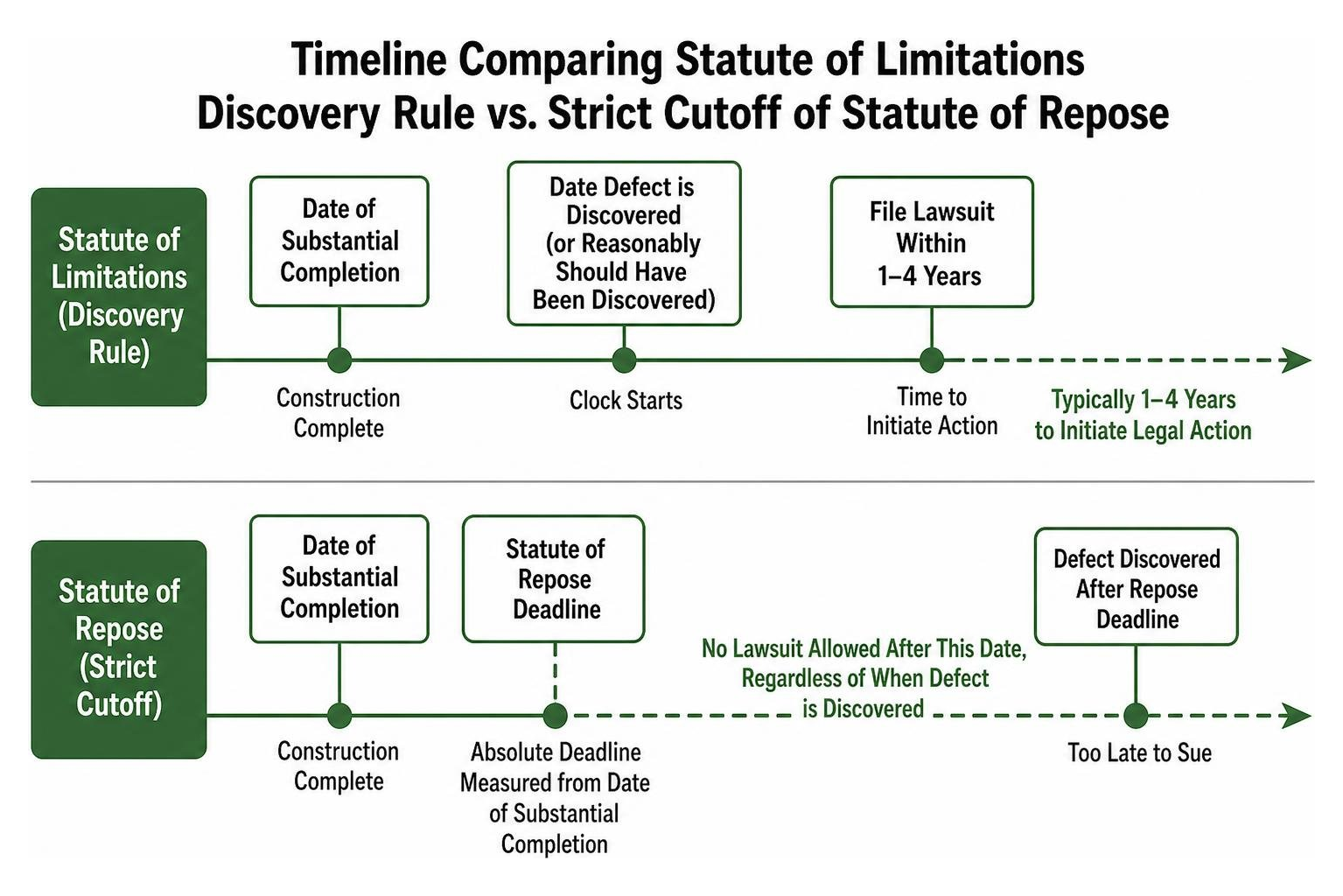
Timing is everything in defect litigation:
- Statute of Limitations: Runs from the date the defect or resulting injury is discovered (or reasonably should have been discovered), typically providing a one- to four-year window to initiate legal action.
- Statute of Repose: Sets an absolute, unyielding deadline measured strictly from the date of substantial completion, regardless of when a latent defect is discovered.
Navigating complex statutory standards and pre-litigation notice protocols, such as everything you need to know about the SB800 manual, is vital to avoid having valid claims barred by statutory cutoffs.
Investigating, Valuing, and Navigating Defect Claims
Proving a claim requires disciplined scientific investigation, accurate cost segregation, and aggressive policy enforcement. Partnering with seasoned litigators through finding the right housing and construction defects attorney near you ensures your technical evidence translates into financial recovery.
Engineering Forensics and Cost Segregation Analysis
Forensic engineers employ non-destructive testing (such as infrared thermography, ground-penetrating radar, and moisture metering) alongside targeted destructive testing to expose underlying flaws. Forensic cost accountants then segregate project estimates into specific buckets:
- Direct Defect Remediation: The direct cost to fix the faulty component (frequently excluded by first-party property policies).
- Resulting Property Damage: The cost to rebuild finishes, structural framing, and dry out interior spaces harmed by the defect (typically covered).
- Code Upgrades and Betterments: Mandatory expenses required to bring older designs into compliance with current building codes during repair.
Avoiding Pitfalls in Construction Defect Insurance Claims
To protect the financial viability of your claim, avoid these common missteps:
- Delayed Notice: Failing to notify carriers immediately can forfeit coverage under strict “late notice” provisions.
- Ignoring Reservations of Rights: Insurers often agree to defend while reserving their right to deny indemnity later; these letters require immediate legal review.
- Unvetted Dispute Forums: Weighing forum choices carefully is essential, as detailed in our guide on why arbitration for construction defects might be your best or worst move.
- Overlooking Punitive or Consequential Exposures: Knowing when bad-faith or severe property damage actions apply is covered in our analysis of punitive damages and property damage.
Proactive Documentation and Risk Mitigation Strategies
- Maintain comprehensive daily construction logs, site photos, and digitally stamped field reports.
- Require subcontractor wrap-up agreements and ensure additional insured endorsements are fully executed.
- Secure per-project aggregate endorsements to prevent policy limits from eroding across unrelated jobs.
Frequently Asked Questions About Construction Defect Insurance
What is the difference between defective work and resulting property damage?
Defective work refers to the faulty construction component itself, such as an improperly installed window or substandard roof flashing. Under most standard CGL and builder’s risk policies, the direct cost to replace or repair that specific defective component is considered an uncovered business risk. Conversely, resulting property damage refers to the physical destruction caused to other non-defective building elements as a consequence of that failure—such as rotted wall framing, ruined interior drywall, and mold growth caused by water leaking past the defective window. Resulting damage is generally covered.
Can property owners or HOAs pursue the contractor’s insurance carrier directly?
In most jurisdictions, a property owner or homeowners association cannot sue a contractor’s CGL carrier directly prior to obtaining a settlement or judgment against the contractor. However, once liability is established or if the contractor is insolvent, bankrupt, or defunct, direct action statutes or assignment of claims agreements allow claimants to pursue the insurer directly to satisfy the judgment.
How do continuous or progressive damage exclusions affect older latent defect claims?
Continuous or progressive injury exclusions (often called “deemer” clauses) attempt to eliminate coverage if property damage began before the policy’s effective date, even if the damage continues to progress undetected into the current policy term. Insurers frequently invoke these endorsements to deny claims involving latent water leaks or foundation settlement that originated years prior, making continuous policy mapping and historical coverage analysis essential.
Conclusion
Resolving multi-layered construction defect disputes requires technical forensic analysis, accurate cost segregation, and aggressive insurance recovery strategies. At Alan L. Frank Law Associates, P.C., we leverage our nationwide litigation experience and track record of multi-million dollar recoveries to protect property owners, developers, and commercial entities facing catastrophic structural failures. For detailed answers to common legal questions regarding building failures, explore our frequently asked questions on housing and construction defects or contact our legal team to evaluate your case.